The Role of Delta Checks in Detecting Laboratory Errors | MLS Guide
In the clinical laboratory, not every abnormal result reflects a true change in a patient’s condition. Sometimes, unexpected values point to laboratory-related issues rather than clinical ones. This is where delta checks become essential.
For Medical Laboratory Scientists (MLS), delta checks act as a critical safety net—helping detect errors early, prevent incorrect reporting, and protect patient care.
.
What Are Delta Checks?
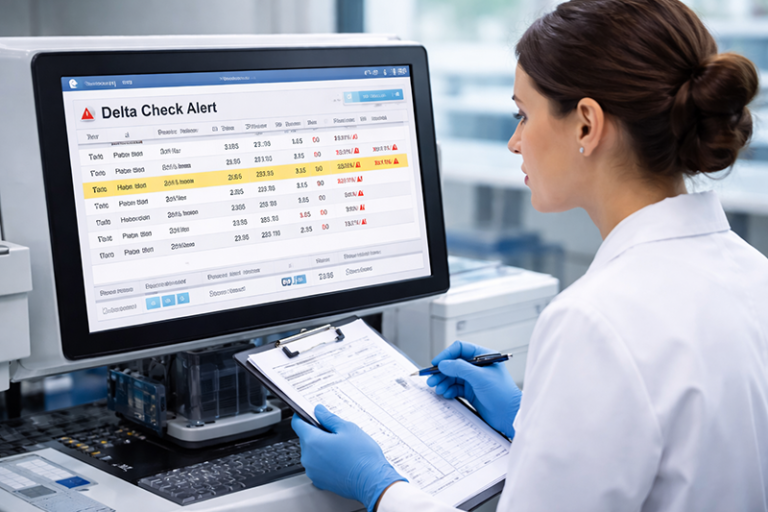
A delta check compares a patient’s current laboratory result with their previous result for the same test. If the change exceeds a predefined acceptable limit, the result is flagged for review.
This process helps answer one crucial question: Does this result make sense for this patient at this time?
Why Delta Checks Matter in the Clinical Laboratory
Delta checks help identify potential problems caused by:
Specimen mislabeling
Sample mix-ups
Hemolysis or dilution
Instrument or reagent issues
Pre-analytical collection errors
Professional organizations such as American Society for Clinical Pathology emphasize result verification as a core responsibility of laboratory professionals.
Common Laboratory Tests Suitable for Delta Checks
Delta checks are most effective for analytes that are usually stable over time, including:
Hemoglobin / Hematocrit
White Blood Cell Count
Platelet Count
Sodium
Potassium
Creatinine
Large, sudden changes in these values often require investigation.
How Delta Checks Help Detect Laboratory Errors
Specimen Identification Errors
A drastic change in hemoglobin or electrolytes without clinical explanation may indicate a wrong patient sample.
Pre-Analytical Problems
Improper collection, IV fluid contamination, or delayed transport can cause unexpected shifts that trigger delta check alerts.
Analytical Issues
Instrument malfunction, calibration errors, or reagent deterioration may lead to inconsistent results detected through delta checks.
What to Do When a Delta Check Is Flagged
When a delta check exceeds allowable limits, MLS professionals should:
Guidance from Clinical and Laboratory Standards Institute supports investigating significant discrepancies before releasing the result.
Limitations of Delta Checks
Delta checks are not always reliable in some situations that involve:
Critically ill patients
Post-surgical cases
Massive transfusions
Chemotherapy or dialysis
In these cases, rapid physiological changes are expected and must be interpreted with clinical correlation.
Best Practices for Effective Delta Check Use
Establish realistic delta limits per analyte
Use delta checks as a screening tool—not an automatic rejection
Combine results with patient history
Document investigations and corrective actions
These practices strengthen laboratory quality assurance and patient safety.
Final Thoughts
Delta checks are more than automated alerts—they are a professional safeguard. When applied correctly, they help Medical Laboratory Scientists detect errors early, maintain result accuracy, and uphold trust in laboratory reporting.
Understanding and applying delta checks reinforces your vital role in delivering reliable, life-impacting results every day.