Kt/V in Urea Post-Dialysis: Understanding Dialysis Adequacy

For patients on hemodialysis, finishing a dialysis session is only part of the story. What really matters is whether the treatment has effectively cleared waste products from the blood.

One of the most trusted ways to measure this is Kt/V.

Doctors, dialysis nurses, and medical laboratory scientists use Kt/V to check if a patient is getting enough dialysis.

Understanding this value is important because it helps guide treatment decisions, improve patient outcomes, and ensure that care meets accepted clinical standards.
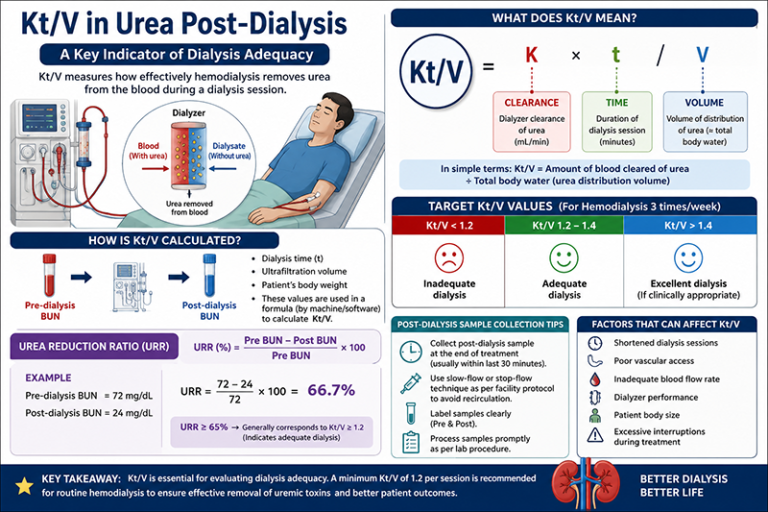
KT/V in Urewa Post-Dialysis

What Is Kt/V ?

Kt/V is a mathematical measurement that estimates how effectively a dialysis session removes urea, a waste product produced during protein metabolism.

The abbreviation stands for:

  • K = Dialyzer clearance of urea (how efficiently the dialyzer removes urea)
  • t = Duration of the dialysis session
  • V = Volume of distribution of urea, which is approximately equal to the patient’s total body water

In simple terms, Kt/V measures how much of the body’s water has been cleared of urea during one dialysis treatment.

Why Is Kt/V Important?

Patients with kidney failure are no longer able to efficiently filter and remove waste products and excess fluids from the blood through their kidneys. Because of this loss of function, harmful substances such as urea and other toxins can build up in the body over time. Hemodialysis serves as an artificial replacement for this vital filtering process by cleansing the blood outside the body. However, for the treatment to be effective, it must remove a sufficient amount of waste to help prevent serious complications and maintain the patient’s overall health and stability.

An adequate Kt/V helps:

  • Remove uremic toxins effectively
  • Reduce symptoms of uremia
  • Improve patient survival
  • Decrease hospitalization rates
  • Meet dialysis quality standards

A low Kt/V suggests that the patient may not be receiving enough dialysis.

The Role of Urea Testing

The laboratory measures:

  • Pre-dialysis Blood Urea Nitrogen (BUN)
  • Post-dialysis Blood Urea Nitrogen (BUN)

These values are used, along with dialysis time and ultrafiltration data, to calculate Kt/V. Most modern dialysis machines and software perform the calculation automatically.

Target Kt/V Values

For patients receiving conventional hemodialysis three times per week:

Kt/V ValueInterpretation
Less than 1.2Inadequate dialysis
1.2–1.4Adequate dialysis
Greater than 1.4Excellent dialysis adequacy (if clinically appropriate)

Clinical guidelines generally recommend a minimum single-pool Kt/V (spKt/V) of 1.2 for each hemodialysis session.

Understanding the Urea Reduction Ratio (URR)

Another commonly used measure is the Urea Reduction Ratio (URR), which provides a simple way to estimate how effectively dialysis removes urea from the blood during a treatment session.

The URR is based on the change in blood urea nitrogen (BUN) levels before and after hemodialysis. It reflects the percentage of urea that has been cleared from the bloodstream.

The formula is:

URR (%) = [(Pre-dialysis BUN − Post-dialysis BUN) ÷ Pre-dialysis BUN] × 100

Example

  • Pre-dialysis BUN = 72 mg/dL
  • Post-dialysis BUN = 24 mg/dL

URR = ((72 − 24) ÷ 72) × 100
URR = (48 ÷ 72) × 100
URR = 66.7%

This means that approximately two-thirds of the urea in the blood was removed during the dialysis session, which indicates effective toxin clearance.

In clinical practice, a URR of 65% or higher is generally considered acceptable and is often associated with a Kt/V of at least 1.2, suggesting adequate dialysis treatment. However, URR should always be interpreted alongside other clinical parameters, as it does not account for factors such as treatment time, patient size, or urea distribution volume.

Proper Collection of Post-Dialysis Urea Samples

Accurate Kt/V calculations rely heavily on how well the blood samples are collected, because even small pre-analytical errors can significantly distort the final interpretation of dialysis adequacy.

For this reason, laboratory professionals play a critical role in ensuring that specimen collection is performed correctly and consistently. They should always begin by strictly following the dialysis unit’s approved sampling protocol, as this is designed to standardize practice and reduce variability between patients and sessions.

When collecting the post-dialysis specimen, it is important to use a standardized and validated technique that minimizes the risk of contamination from blood recirculation. Improper timing or technique can falsely elevate or reduce urea levels, leading to inaccurate Kt/V results and potentially misleading clinical decisions.

Clear and accurate labeling of both pre-dialysis and post-dialysis samples is also essential. This ensures proper identification in the laboratory and prevents mix-ups that could compromise patient safety and data integrity.

Once collected, samples should be processed promptly in accordance with established laboratory procedures to maintain specimen stability and analytical accuracy.

Because sampling methods may differ between institutions—such as the use of slow-flow or stop-flow techniques—it is always important to adhere to your facility’s specific policy and guidelines. Consistency in following these protocols is key to producing reliable and clinically meaningful Kt/V results.

.

Factors That Can Affect Kt/V

Several factors may influence dialysis adequacy, including:

  • Shortened dialysis sessions
  • Poor vascular access
  • Inadequate blood flow rate
  • Dialyzer performance
  • Patient body size
  • Excessive interruptions during treatment

When Kt/V is consistently below target, the dialysis prescription should be reviewed by the healthcare team.

Frequently Asked Questions

Is a higher Kt/V always better?

Not necessarily. Hitting the recommended target is important, but doing more dialysis than needed doesn’t always lead to extra benefits for every patient. Treatment should always be tailored to the individual.

Can the laboratory calculate Kt/V?

Laboratories supply the pre- and post-dialysis urea results that are used to compute the value. In many dialysis units, this calculation is automatically performed by the dialysis machine or integrated clinical software.

Why is post-dialysis timing important?

Improper sample collection can significantly distort BUN results, which may lead to a misleading evaluation of how effective the dialysis session was. For example, if the sample is taken too early, too late, or not handled correctly, the urea level may not truly reflect the patient’s post-dialysis status. This is why strict adherence to standardized collection procedures is essential—it ensures that the results are accurate, consistent, and truly representative of the patient’s dialysis adequacy.

Key Insights

  • Kt/V is a widely used way to check how effective a dialysis session has been. In simple terms, it tells us how well hemodialysis is clearing urea from the blood.
  • For most patients on regular hemodialysis, a Kt/V value of at least 1.2 is considered the minimum target to ensure adequate treatment.
  • To get a reliable Kt/V result, it is very important to measure urea levels correctly both before and after dialysis. Any error in timing or sample handling can affect the final calculation.
  • Because of this, proper specimen collection and correct laboratory procedures are essential in making sure the results truly reflect the patient’s dialysis adequacy.

Summary

Kt/V is one of the most useful ways to assess how effective hemodialysis is. While the calculation can look technical at first, its goal is simple: to make sure patients are getting enough dialysis to properly remove waste products and support better health.

For medical laboratory scientists, having a clear understanding of Kt/V—and collecting urea samples correctly—plays an important role in ensuring accurate results and ultimately improving patient care.

Scroll to Top