ASCP

Illustration of laboratory pipetting and an RPR card, titled The Prozone Effect: When antibody excess hides a reaction.

Prozone Effect in RPR Testing: An ASCP Study Guide

Prozone Effect in RPR Testing: An ASCP Study Guide Can excess antibody make a test appear negative? Yes—the prozone effect is an important example. Why it happens Rapid plasma reagin (RPR) testing depends on visible flocculation. When antibodies are excessive, they can interfere with the cross-linking needed to produce a visible reaction. An undiluted specimen

Prozone Effect in RPR Testing: An ASCP Study Guide Read More »
, , , ,

CSF Differential With Fewer Than 100 Cells: A Practical Reporting Guide

A cerebrospinal fluid (CSF) differential is ideally based on 100 identifiable nucleated cells—but low-cellularity specimens do not always provide that many. When the entire usable cytospin area contains fewer than 100 cells, the correct response is not to invent, duplicate, or “round up” cells. Count the cells that are actually present, document the denominator, and

CSF Differential With Fewer Than 100 Cells: A Practical Reporting Guide Read More »

, , , , , , ,
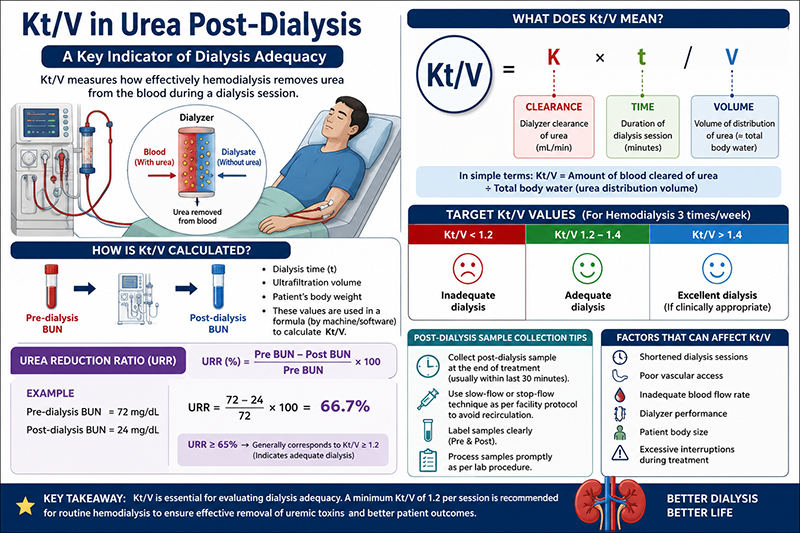
KT/V in Urewa Post-Dialysis

Kt/V in Urea Post-Dialysis

Kt/V in Urea Post-Dialysis: Understanding Dialysis Adequacy For patients on hemodialysis, finishing a dialysis session is only part of the story. What really matters is whether the treatment has effectively cleared waste products from the blood. One of the most trusted ways to measure this is Kt/V. Doctors, dialysis nurses, and medical laboratory scientists use

Kt/V in Urea Post-Dialysis Read More »

, , , , , , , , , , , , , ,
Scroll to Top