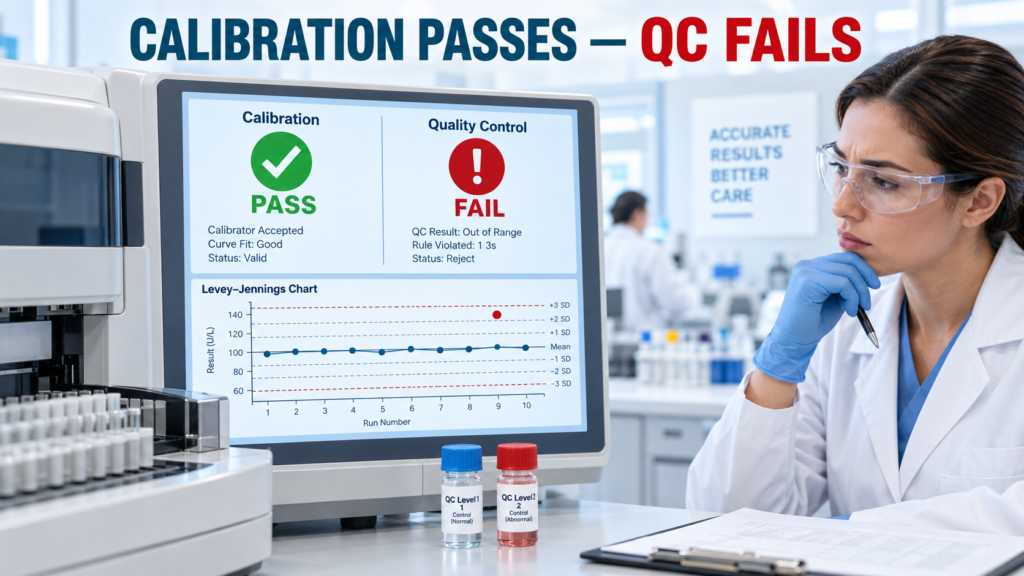
A successful calibration does not guarantee that quality-control results will fall within the acceptable range. Calibration and quality control evaluate different parts of the testing process, so it is entirely possible—and important—for calibration to pass while QC fails.
When this happens, the QC failure must be investigated before patient results are released.
Calibration and QC Are Not the Same
Calibration establishes the relationship between the analyzer’s signal and the concentration or activity of an analyte. A passed calibration means the instrument accepted the calibration data according to the manufacturer’s criteria.
Quality control evaluates whether the complete analytical system remains stable and capable of producing reliable patient results. It can detect problems involving:
- Control material
- Reagents
- Calibration
- Instrument performance
- Environmental conditions
- Preparation and handling
- Random or systematic analytical error
Therefore, an accepted calibration only confirms that the calibration process met its acceptance criteria. It does not eliminate every possible cause of QC failure.
First: Review the QC Pattern
Before repeating anything, examine the current result and the Levey–Jennings chart.
- Is only one control level affected?
- Are all QC levels shifting in the same direction?
- Is the failure isolated or part of a developing trend?
- Is the result beyond ±2 SD or ±3 SD?
- Which Westgard rule was violated?
- Did the problem begin after a reagent, calibrator or QC lot change?
- Is the result consistent with random error or systematic error?
The QC pattern helps determine where the investigation should begin.
1. Check the Control Material
Control-related problems are common and should be assessed first. Verify:
- Correct control lot and assigned target range
- Expiration date and open-vial stability
- Proper storage temperature
- Correct reconstitution procedure and equilibration time
- Adequate mixing before analysis
- Absence of bubbles, evaporation, contamination or deterioration
- Correct QC level placed in the correct position
If the control may have been compromised, prepare or open fresh material according to the manufacturer’s instructions and repeat the test.
2. Check the Reagent
A valid calibration may remain stored even when the reagent subsequently develops a problem. Review:
- Reagent lot and expiration date
- Onboard stability and storage conditions
- Reagent volume, bottle position and barcode information
- Evidence of bubbles, foam, contamination or precipitation
- Whether a new shipment or bottle was recently loaded
- Any reagent warnings or analyzer alarms
If appropriate, replace the reagent and perform the required calibration or reagent-lot procedure before repeating QC.
3. Confirm the Calibration Details
Although the calibration passed, confirm that it is appropriate for the reagent currently in use. Check:
- Calibrator lot and expiration
- Calibration type and validity period
- Reagent lot linked to the calibration
- Calibration curve, factors or response values
- Lot-specific assigned values
- Instrument flags or warnings
- Whether calibration verification is required
- Whether the laboratory’s acceptance criteria were met
Do not assume that “accepted” automatically means clinically suitable. An unusual calibration curve or response may still warrant investigation.
4. Inspect the Analyzer
Instrument-related problems can affect QC even after calibration is accepted. Consider:
- Probe obstruction or carryover
- Inadequate washing
- Pipetting or aspiration problems
- Cuvette contamination
- Temperature instability
- Photometer or detector problems
- Water quality
- Incorrect reagent or sample volume
- Recent maintenance or part replacement
- Analyzer alarms and maintenance logs
Perform only the maintenance and corrective actions permitted by the manufacturer’s instructions and the laboratory SOP.
5. Review Environmental and Handling Factors
Some failures occur outside the analyzer. Check room and refrigerator temperatures, humidity when relevant, water quality, power interruptions, thawing or reconstitution, delays after preparation, mixing, pipetting technique and target-entry errors.
A technically correct analyzer run cannot compensate for incorrectly prepared or poorly stored material.
A Practical Troubleshooting Sequence
- Stop and hold affected patient results.
- Review the QC result, chart and violated rule.
- Check the control’s lot, expiration, storage and preparation.
- Repeat QC once only when a random error or handling issue is reasonably suspected.
- Use fresh control material when deterioration is possible.
- Review the reagent’s lot, stability, condition and recent changes.
- Confirm the calibration is correctly linked to the active reagent lot.
- Inspect analyzer flags, maintenance status and environmental conditions.
- Replace suspect material or perform appropriate maintenance.
- Recalibrate only when justified or required by the manufacturer.
- Confirm acceptable QC before releasing patient results.
- Document the failure, investigation, corrective action and final outcome.
Avoid Repeating QC Until It Passes
Repeatedly running the same control without investigating the cause can conceal a genuine analytical problem. A passing result obtained after several unexplained repeats does not prove that the system is stable. Every repeat should have a documented reason.
When Should Patient Testing Resume?
Patient results should be released only after the cause has been investigated, appropriate corrective action has been completed, QC is acceptable according to laboratory policy, the analytical system is considered stable, potentially affected patient results have been evaluated when necessary, and all actions are documented.
Key Takeaway
Calibration asks: Can the analyzer establish an acceptable measurement relationship?
Quality control asks: Is the entire analytical system performing reliably right now?
That is why calibration can pass while QC fails. The safest response is not automatic recalibration or repeated QC testing—it is a structured investigation based on the QC pattern, control material, reagents, calibration data, analyzer condition and laboratory procedures.
Educational note: Always follow the current manufacturer’s instructions, your laboratory SOP and applicable accreditation requirements.
#QualityControl #LaboratoryCalibration #QCTroubleshooting #ClinicalChemistry #WestgardRules #LeveyJennings #MedicalLaboratoryScience #LabQuality #AnalyzerTroubleshooting #PatientSafety